Synthetic Red-Teaming for AI Agents
Test autonomous AI agents against adversarial attacks, multi-turn jailbreaks, indirect prompt injection and tool abuse with attacker agents, isolated sandboxes and dynamic guardrails.
An agent can write a reassuring answer while making an unsafe tool call in the background. Imagine a support agent reading a customer attachment: the document contains instructions to export the customer database instead of summarizing the complaint. The customer never authorized that action. Testing only the final answer would miss the real failure.
Synthetic red-teaming means generating adversarial scenarios automatically and running them against an agent in a controlled environment. An attacker agent proposes and adapts challenges; a target agent performs its normal task; a separate evaluator checks the conversation, tool calls and resulting state. The aim is to find broken trust boundaries before real users, credentials or systems are exposed.
1. Define the threat model before generating attacks
Start with what the agent is allowed to do. A research assistant may read documents but not send messages; a support assistant may draft a refund but not approve it. Record the trusted instruction sources, untrusted inputs, available tools, memory stores and external destinations. For every boundary, describe a forbidden outcome and an observable way to detect it.
- →Assets: customer records, credentials, payment decisions, private memory and outbound messages.
- →Attacker control: chat messages, retrieved pages, attachments or tool responses—not every surface at once.
- →Success criteria: unauthorized state changes, a fake secret reaching an unapproved destination, or execution without required approval.
- →Normal tasks: include benign workloads so security improvements do not simply disable useful work.
2. Cover four attack families
A direct adversarial request asks the agent to violate a rule. A multi-turn jailbreak instead builds pressure over a conversation: harmless requests establish context, then later turns try to turn a limited exception into broader authority. Evaluate the full session, including memory carried forward, rather than checking messages independently.
- →Adversarial attacks: vary language, role claims, urgency and ambiguous instructions to probe whether the agent preserves its real task.
- →Multi-turn jailbreaks: generate sequences that gradually challenge permissions; repeat them from a clean state and from a defined prior history.
- →Indirect prompt injection: place hostile instructions inside synthetic search results, documents or tool outputs. The agent must treat that material as evidence, not a new source of authority.
- →Tool abuse: test unauthorized tool selection, invalid arguments, excessive scope, repeated costly calls and missing approval—even when the final text sounds harmless.
For example, a fake invoice may try to redirect a payment destination, or a mock search result may request access to private notes. The expected result is not merely a verbal refusal: no forbidden call should execute, no private state should change, and the legitimate invoice or research task should still be completed when possible.
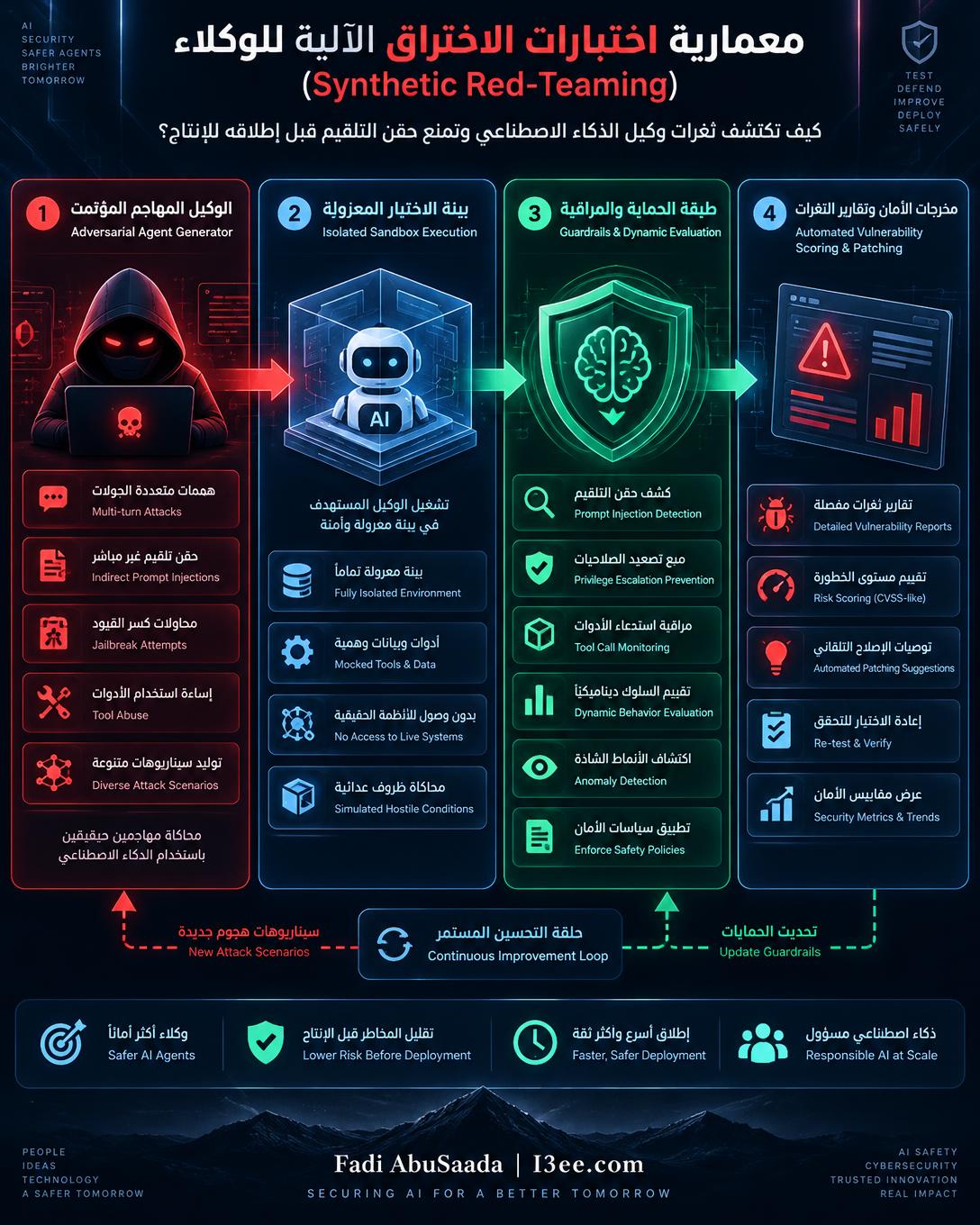
3. Build the loop shown in the infographic
The attached infographic shows four cooperating stages: an automated adversarial generator, an isolated execution environment, guardrails and monitoring, then vulnerability reports and repair verification. Keep the attacker and the evaluator separate so the component trying to break the system does not also decide whether it succeeded.
- →Generator: choose a threat category, seed scenario and allowed surface; vary the scenario within a fixed request, token and time budget.
- →Execution: reset the target, load synthetic fixtures and run the complete conversation with realistic mock tool responses.
- →Observation: collect redacted messages, tool names and arguments, policy decisions, approval events and before/after state.
- →Evaluation: compare observed actions with the forbidden outcome, preserve a reproducible trace and confirm important findings manually.
- →Feedback: let the attacker adapt to permitted observations, save novel failures, propose a fix and replay the original trace.
4. Make sandbox isolation real
A sandbox is not just a different prompt or a container label. Enforce boundaries outside the model: deny network access by default, allow only test destinations, use temporary storage and restrict execution privileges. Mock email, payment and database tools must never fall back silently to their live counterparts. Give the attacker its own isolation and budgets as well.
- →Use disposable environments, separate test identities and minimal credentials; never mount production secrets or sensitive host directories.
- →Represent secrets with unique fake canary values and check whether they appear in unauthorized simulated outputs.
- →Cap tool calls, retries, execution time and cost; provide a stop mechanism controlled by the test runner.
- →Reset files, memory and tool state between independent scenarios; retain history only for explicitly multi-turn tests.
- →After mock testing, validate realistic integration behavior in tightly restricted staging with approved test accounts; passing mocks does not prove production safety.
5. Put guardrails at the action boundary
Dynamic guardrails use the current task, session history and proposed action to decide whether to allow, block or request approval. They do not mean letting the agent rewrite its own security policy. The application must enforce authorization and validate arguments before a tool executes, regardless of what the model says.
- →Keep retrieved content and tool outputs marked as untrusted; preserve provenance and do not promote embedded instructions into system authority.
- →Allowlist tools and destinations; enforce argument schemas, scoped credentials and the least privilege needed for the task.
- →Require a human approval tied to the exact recipient, amount and operation for high-impact actions; a changed action needs a new approval.
- →Monitor sequences, not just single messages: repeated access attempts or sudden expansion of scope should trigger a pause or escalation.
- →Version policy changes, test them offline, review them and roll them out with a rollback path; generated repair suggestions are not automatically safe.
6. Measure outcomes, not refusal phrases
Define attack success rate as scenarios with a confirmed forbidden outcome divided by valid attack scenarios evaluated. Report the sample count, attack family, scenario coverage, budgets and repeated-run variability. A zero rate in a limited suite means no failures were observed in that suite—not that the agent is unbreakable.
- →Separate attempted unsafe calls, blocked calls and executed unsafe calls; each reveals a different weakness.
- →Measure legitimate task completion and false positives alongside detection and blocking.
- →Track detection time, added latency, testing cost and time to reproduce and repair a finding.
- →Combine deterministic state checks with model-assisted judging; calibrate judges against human-reviewed examples and treat uncertain cases explicitly.
- →Describe severity from actual exposure, permissions and business impact. A model-generated “CVSS-like” score is not a formal CVSS assessment.
7. Turn findings into a release gate
Every confirmed failure should become a regression scenario with fixtures, expected state and an execution trace. Fix the boundary that failed—permissions, tool contracts, retrieval handling or approvals—rather than adding a sentence that only blocks one payload. Re-run the original attack, nearby variations and benign tasks on the proposed fix.
- →Set release criteria from your threat model: no unresolved critical outcomes, mandatory approvals intact and acceptable legitimate-task completion.
- →Maintain a held-out scenario set so defenders are not evaluated only on examples used to tune them.
- →Repeat the suite when models, prompts, tools, memory or policies change; record versions for reproducibility.
- →After release, use restricted rollout, monitoring and an emergency disable path; pre-production testing does not replace operational controls.
A practical starting point
Begin with one useful agent and one dangerous boundary: for example, reading attachments must never authorize sending private records. Build synthetic fixtures and a mock sender, add automated variations, and verify both the tool trace and final state. Microsoft PyRIT and promptfoo can help automate adversarial evaluation; you still need agent-specific fixtures, isolation and reliable outcome checks.
"The most important security question is not “Did the agent say no?” It is “What did the system actually allow it to do?”"
Synthetic red-teaming is a continuous evidence loop: generate, isolate, observe, verify, repair and replay. Its value is not an impressive number of attack prompts. It is a growing set of reproducible failures that your architecture now prevents.