Context Drift Architecture in Long-Horizon AI Agents
Why long-running AI agents gradually forget the original mission — and how dynamic context pruning, hierarchical summarization, explicit goal state, checkpoints, and drift metrics keep them focused.
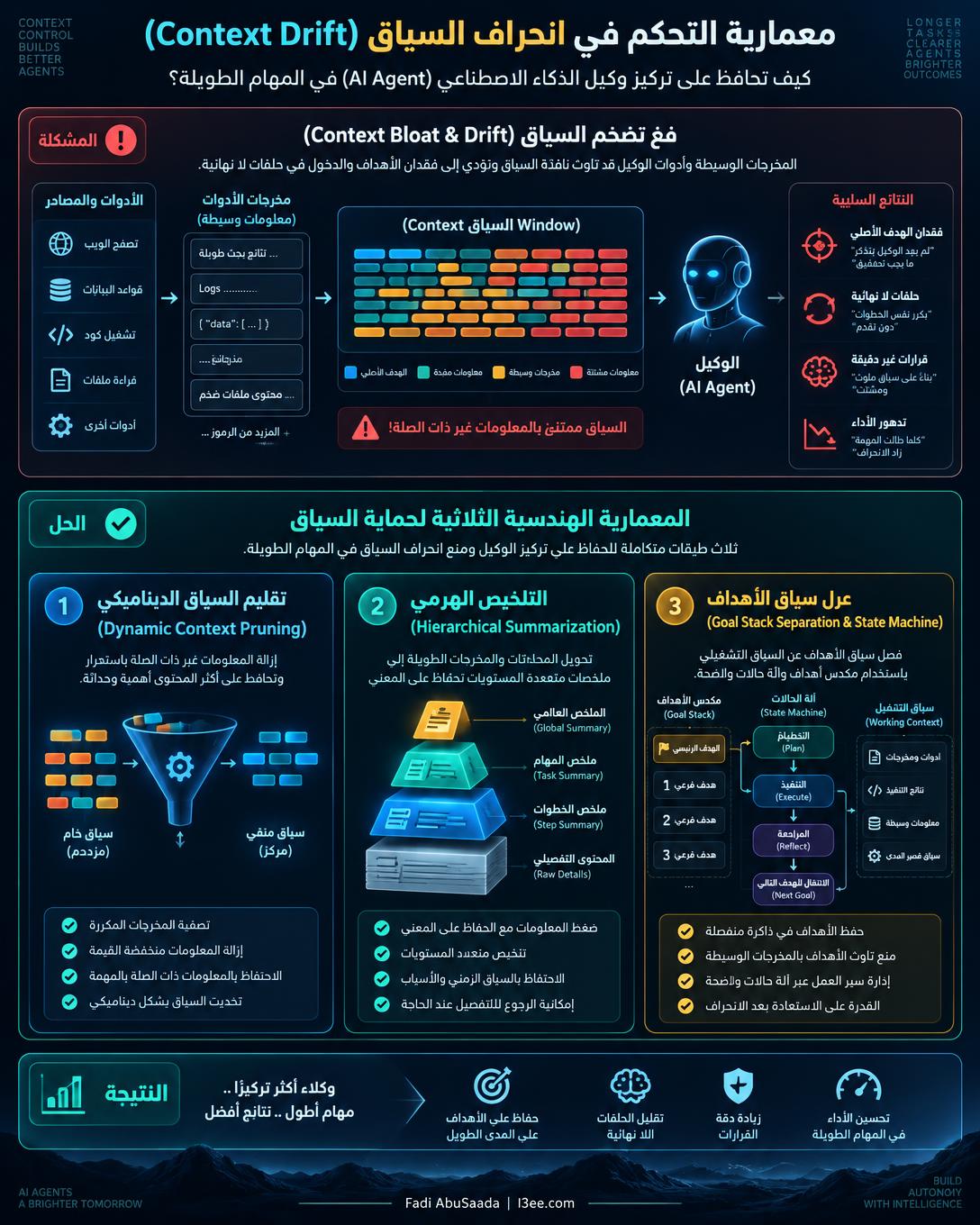
Why does an AI agent that understood the task perfectly at step one start making strange decisions at step fifty? It did not suddenly become less intelligent. Its working context became crowded with tool logs, intermediate drafts, repeated instructions, temporary facts, and failed attempts. The original goal is still present somewhere — but it no longer dominates the signal.
This is context drift: the agent's active representation of the mission slowly diverges from the mission itself. A larger context window delays the problem but does not solve it. Long-horizon agents need an architecture that continuously removes noise, compresses history, and stores goals as explicit state instead of hoping the model rediscovers them from a transcript.
1. Why the Agent Forgets
Imagine asking an agent to plan a product launch, research competitors, prepare a budget, and draft the campaign. By the time it has opened dozens of pages, called several tools, revised the budget twice, and discussed a side issue, the context contains far more evidence about recent activity than about the original success criteria. Recency begins to outrank importance.
- →Tool-output accumulation — raw search results, API responses, logs, and code consume attention long after their useful conclusion was extracted
- →Instruction dilution — stable constraints compete with newer conversational details and may be followed inconsistently
- →Conflicting state — old plans and revised plans remain together, leaving the model to guess which version is authoritative
- →Lost-in-the-middle effects — critical information buried inside a long window is less reliably retrieved than information near its edges
- →Local optimization — the agent completes the latest subtask well while quietly moving away from the overall objective
2. Layer One: Dynamic Context Pruning
The first control layer treats context as a limited working set, not an archive. Before every model call, a context builder scores candidate items by relevance, authority, freshness, and dependency on the current step. Low-value material is removed; essential facts and active constraints are protected.
- →Discard duplicate outputs once their result has been recorded
- →Replace large tool responses with structured facts and source references
- →Expire temporary observations after the subtask that needed them closes
- →Pin non-negotiable constraints so pruning cannot remove them
- →Budget tokens by role: goals first, current state second, evidence third, conversational history last
3. Layer Two: Hierarchical Summarization
Flat summaries eventually become another bloated transcript. Hierarchical summarization compresses at several levels: individual tool calls become step summaries; related steps become task summaries; completed tasks become a compact global record. The agent loads the smallest level that answers its present need and can expand a source when detail matters.
- →Raw evidence — immutable source material, stored outside the prompt and retrievable by reference
- →Step summary — what was attempted, what changed, what failed, and the evidence produced
- →Task summary — the current conclusion, unresolved questions, decisions, and next action
- →Global summary — stable progress toward the mission, major risks, and the current high-level plan
- →Provenance links — every compressed claim points back to raw evidence so the agent can verify rather than trust a lossy summary
4. Layer Three: Separate Goals from Conversation
Goals should not live only in prose. Store them in a durable goal stack and state machine: mission, success criteria, constraints, current phase, active subgoal, completed subgoals, blockers, and allowed transitions. The model proposes a transition; deterministic application logic validates and commits it.
- →Working context — only what the agent needs for the next decision
- →Durable state — authoritative goals, constraints, plans, approvals, and progress that survive context rebuilds
- →Episodic memory — prior attempts and outcomes retrieved only when they are relevant
- →Next-goal contract — each step declares which goal it serves and what evidence will mark it complete
- →State transitions — plan, execute, verify, recover, or escalate; no silent jump from one phase to another
5. Detecting and Recovering from Drift
A production agent needs a control loop, not just memory. At checkpoints, an independent evaluator compares the current plan and recent actions with the durable goal state. If alignment falls below a threshold, execution pauses, the context is rebuilt from trusted state, and the agent either resumes from the last valid checkpoint or asks a human to resolve ambiguity.
- →Goal-alignment score — does the proposed action advance an active success criterion?
- →Constraint-retention rate — are fixed requirements still present and obeyed after many steps?
- →State contradiction count — how often do summaries, plans, and durable facts disagree?
- →Recovery frequency and cost — how often does the agent roll back, rebuild context, or escalate?
- →Long-horizon completion rate — can it finish the real mission, not merely produce good-looking intermediate outputs?
6. Practical Failure Modes
- →Over-pruning removes a weak signal that later becomes decisive; keep provenance and allow selective expansion
- →Summary corruption compounds across levels; verify critical facts against raw evidence before promoting them
- →A stale goal state preserves yesterday's plan too faithfully; every approved change needs an explicit state update
- →Checkpointing every step creates latency and cost; trigger deep checks at phase boundaries, risky actions, or weak confidence
- →A verifier built from the same context can share the same drift; give it durable goals and independent evidence
7. A Simple Adoption Path
- →Start by moving goals and constraints from chat history into structured durable state
- →Replace raw tool outputs with concise structured observations and links to the originals
- →Introduce step, task, and global summaries with explicit provenance
- →Add checkpoints before irreversible actions and at the end of every major phase
- →Measure goal alignment and end-to-end completion on tasks that require dozens of steps
"A long context remembers more text. A well-designed agent remembers what matters, knows what changed, and can prove which goal it is pursuing."
The Architectural Takeaway
The cure for context drift is not endlessly expanding the prompt. It is separating working context from durable state, compressing history without losing provenance, and checking every important transition against explicit goals. Dynamic pruning keeps the desk clean, hierarchical summaries preserve the story, and a goal state machine keeps the destination fixed. Together they turn a fluent agent into one that can stay focused across hours, tools, and hundreds of decisions.