Model Context Protocol (MCP): The Universal Standard for AI Integration
Every new tool used to mean a new custom integration. How the Model Context Protocol replaces point-to-point spaghetti with one open standard — Host, Client, Server architecture over JSON-RPC 2.0, and three primitives (Prompts, Resources, Tools) that turn any agent into a universal integrator.
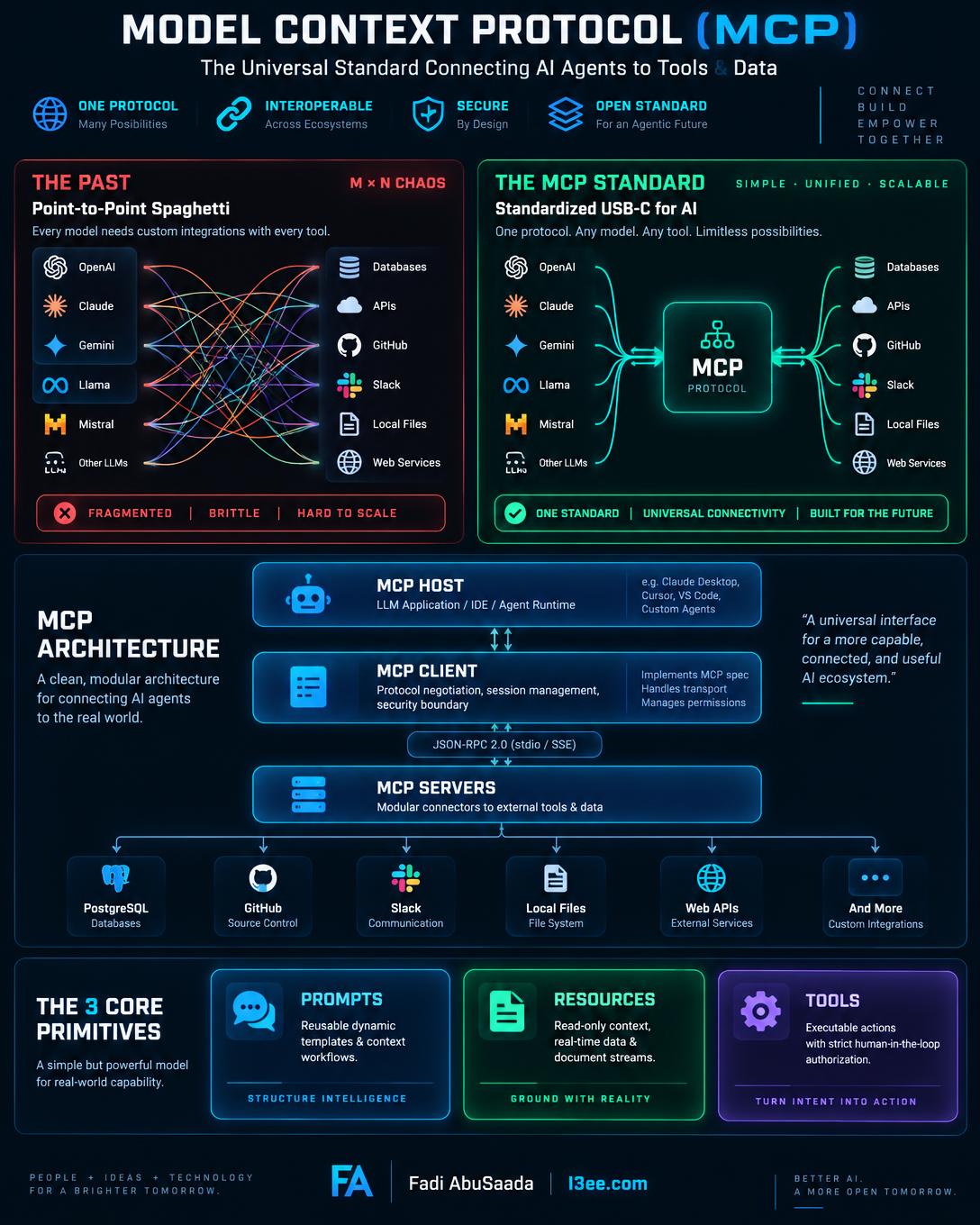
Building an AI agent used to follow a painful ritual: pick the model, then wire it by hand to every system it needs — a custom connector for Slack, another for GitHub, a third for Postgres, each with its own auth quirks, retry logic, and failure modes. Then the next model arrives, and you rebuild the same integrations all over again. This article covers the standard that ends this: the Model Context Protocol (MCP).
The core idea is USB-C for AI applications. Instead of every model needing a bespoke cable to every tool, everyone agrees on one plug. MCP is an open standard, adopted by OpenAI, Anthropic, Google, and the broader ecosystem, that defines how AI applications discover and use external capabilities — not what those capabilities are.
1. The M × N Integration Problem
Before MCP, every integration was point-to-point, and the math is brutal:
- →M models × N tools = M×N integrations — five models and seven services mean 35 bespoke connectors, each written, secured, and maintained separately
- →Every integration is bespoke — different auth schemes, rate limits, error shapes, and data formats; nothing is reusable across models
- →Brittle by construction — one API change in one service breaks one connector, in ways the team only discovers at runtime
- →Hard to scale — adding one new tool means touching every model's codebase; adding one new model means rewriting every integration
- →Duplicated effort everywhere — the same Slack connector gets rebuilt by every team, every product, every vendor, slightly differently each time
2. The MCP Architecture: Host, Client, Server
MCP splits the world into three roles with clean contracts between them:
- →MCP Host — the AI application the user interacts with: Claude Desktop, Cursor, VS Code, or your own custom agent runtime; it owns the model and orchestrates the work
- →MCP Client — lives inside the host; each client maintains a stateful 1:1 connection with one server, handling protocol negotiation, session management, and the security boundary
- →MCP Server — a modular connector exposing one capability domain: Postgres, GitHub, Slack, local files, or an internal web API; it declares its capabilities and answers requests
- →JSON-RPC 2.0 underneath — all communication between clients and servers is JSON-RPC 2.0 messages over stdio for local processes, or HTTP with Server-Sent Events (SSE) for remote services
- →Security by isolation — the host mediates everything: servers never see each other, credentials stay inside the host's boundary, and capabilities flow through explicit permission checks
3. The Three Primitives: Prompts, Resources, Tools
The entire protocol is built on three server-exposed primitives, each with a distinct role:
- →Prompts — reusable, dynamic templates and parameterized workflows; they structure intelligence, turning best-practice instructions into versioned, shareable context
- →Resources — read-only context: files, database rows, and live data streams exposed as URIs; they ground the model in reality without granting any write power
- →Tools — executable functions the model calls to act: query an API, run a migration, send a message; they turn intent into action under strict human-in-the-loop authorization
- →Controlled by the host — which prompts, resources, and tools an agent can reach is decided by the host's permission model, not by the server's ambition
"Prompts structure the intelligence, resources ground it in reality, and tools turn it into action. Three primitives are enough — everything else is plumbing."
4. Why MCP Matters in Production
For enterprises and engineers building on agents, the protocol changes the economics:
- →Write once, integrate everywhere — one server implementation serves every MCP-compatible model and client, collapsing M×N into M+N
- →Vendor-neutral by design — swap or add models without rewriting a single connector; the standard, not the vendor, defines the interface
- →Ecosystem leverage — thousands of prebuilt servers (databases, SaaS tools, file systems) already exist; teams assemble capability instead of rebuilding it
- →Governed access — the client-host boundary gives security teams one place to enforce authentication, permissions, and audit trails
- →The future of agentic workflows — agents that compose tools across vendors, teams, and companies need a shared language; MCP is becoming it, the way HTTP did for the web
The Architectural Takeaway
MCP does for AI integration what USB-C did for hardware and HTTP did for the web: it removes the combinatorial explosion by making one side of the equation a constant. Agents stop being bespoke wiring projects and become composable consumers of an open ecosystem of capability servers. The teams that invest in well-designed MCP servers — clean resources, safe tools, sensible prompts — will plug into every future model without paying the integration tax again.