Beyond Vector Search: Hybrid Search & Re-ranking in Production RAG
Why vector-only retrieval breaks on exact identifiers, code, and domain jargon — how dual retrieval (BM25 + dense embeddings), Reciprocal Rank Fusion, and cross-encoder re-ranking build production-grade RAG.
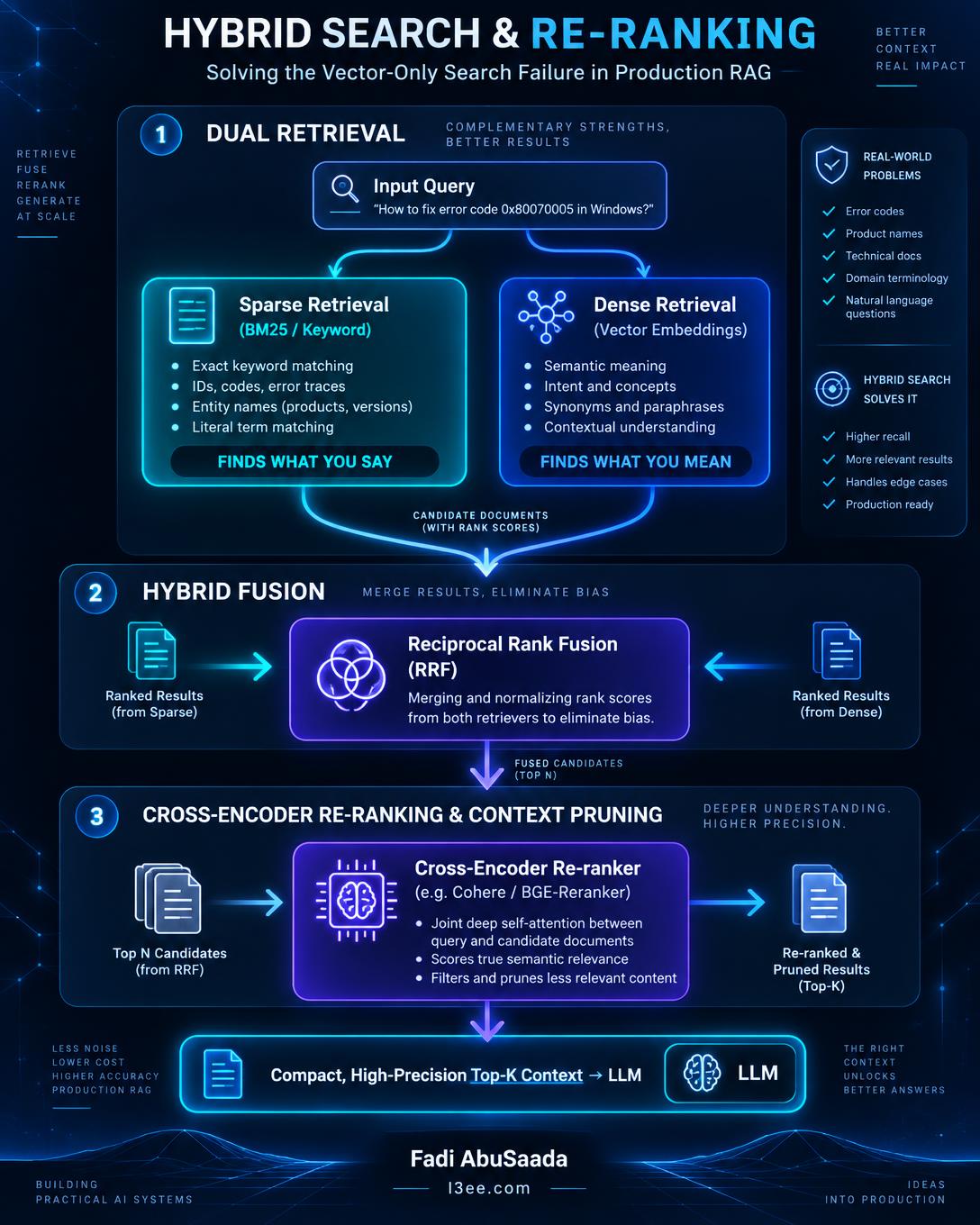
Embedding-based retrieval is the default heart of every modern RAG pipeline — and it fails in a way that surprises teams the first time a real user types something like "how to fix error code 0x80070005 in Windows?". The vector search returns documents about Windows errors in general, about troubleshooting, maybe about other error codes entirely. The exact identifier that would pinpoint the answer is sitting in your knowledge base, and the embedding model simply cannot see it. This article maps the retrieval architecture that fixes this: hybrid search and re-ranking.
The core problem is that embeddings compress meaning into a fixed-size vector. Compression is wonderful for fuzzy semantic similarity — and catastrophic for literal precision. Production users don't only ask fuzzy questions; they paste stack traces, product SKUs, API names, legal clause numbers, and internal jargon. A retrieval strategy built on dense vectors alone was never designed for that half of the traffic.
1. Why Vector-Only Search Fails in Production
Dense embeddings are trained to capture semantic similarity, and they do it well — but production queries constantly hit the corners where similarity is the wrong signal:
- →Exact identifiers — error codes, ticket numbers, model versions, and SKUs carry their meaning in the literal string, not in a semantic neighborhood; embeddings blur them into unrelated documents
- →Code and API references — function names, config flags, and stack traces are token sequences where every character matters; vector space treats them as noise
- →Domain jargon and abbreviations — internal terminology, product names, and niche acronyms are poorly represented in general-purpose embedding spaces, so the nearest neighbors are semantically close but practically wrong
- →Out-of-domain queries — embedding models degrade silently outside their training distribution; you get confident-looking results with no signal that retrieval quality just collapsed
2. Dual Retrieval: Sparse + Dense
The production answer is to run two complementary retrievers in parallel on the same query. Sparse retrieval — classic BM25 keyword search — finds what you say: exact term matching, inverted indexes, precise handling of IDs, codes, error traces, and entity names. Dense retrieval — vector embeddings — finds what you mean: semantic meaning, intent, synonyms, paraphrases, and contextual understanding.
- →BM25 (sparse) — exact keyword matching, identifiers and error codes, entity names like products and versions, literal term matching
- →Dense embeddings — semantic meaning, intent and concepts, synonyms and paraphrases, contextual understanding
- →Complementary, not competing — the query "fix error 0x80070005" is retrieved by BM25 through the literal code, and by dense search through its semantic neighborhood; the union covers what either alone would miss
3. Reciprocal Rank Fusion: Merging Without Bias
Running two retrievers produces two ranked lists — and a new problem: their scores are incomparable. BM25 scores and cosine similarities live on completely different scales, so naively adding them biases the merge toward whichever retriever produces bigger numbers. Reciprocal Rank Fusion (RRF) sidesteps the entire problem by merging on ranks instead of scores: each document's fused score is the sum of 1/(k + rank) across both lists, where rank is its position and k is a small smoothing constant.
- →Scale-free — RRF never compares raw scores, only positions, so no score normalization or calibration is needed between retrievers
- →Fair by construction — a document ranked 3rd by both retrievers beats one ranked 1st by one and 80th by the other, which is exactly the consensus behavior you want
- →Robust default — k≈60 dampens the influence of any single list's top ranks, making the fusion stable even when one retriever has a bad day
4. Cross-Encoder Re-Ranking: The Precision Layer
Fusion gives you a solid merged candidate list — but both retrievers scored each document independently, without ever reading the query and the document together. A cross-encoder re-ranker (such as BGE-Reranker or Cohere Rerank) closes that gap: it feeds the query and each candidate document through the model jointly, computing full self-attention between them, and scores true semantic relevance rather than a compressed similarity proxy.
- →Joint deep attention — query and candidate are encoded together, so subtle relevance signals that bi-encoders compress away survive
- →Top-N in, top-K out — re-rank the top N fused candidates (e.g. 25–50) and keep the best 3–5: a high-precision context window instead of a diluted one
- →Priced correctly — cross-encoders are too slow to score a whole corpus, but applied to a small candidate set they cost milliseconds while multiplying retrieval precision
"Bi-encoders decide who gets an interview. The cross-encoder decides who gets the job."
The Architectural Takeaway
Hybrid retrieval + RRF fusion + cross-encoder re-ranking is the standard production pattern for a reason. Grounding the LLM on 3–5 genuinely relevant passages instead of 10 loosely related ones means less hallucination, fewer wasted input tokens on every request, and dramatically more stable answers — the retrieval layer stops being the weak link in the chain. The final shape is compact and boring, which is exactly what production architecture should look like: dual retrieval for recall, rank fusion for fairness, re-ranking for precision, and a high-precision top-K context handed to the model.