Agentic Memory Architecture: Beyond Context Window Expansion
A million-token context window is not memory. How production agents combine working memory, episodic experience, semantic knowledge graphs, and a consolidation pipeline to stay coherent — and get better over time.
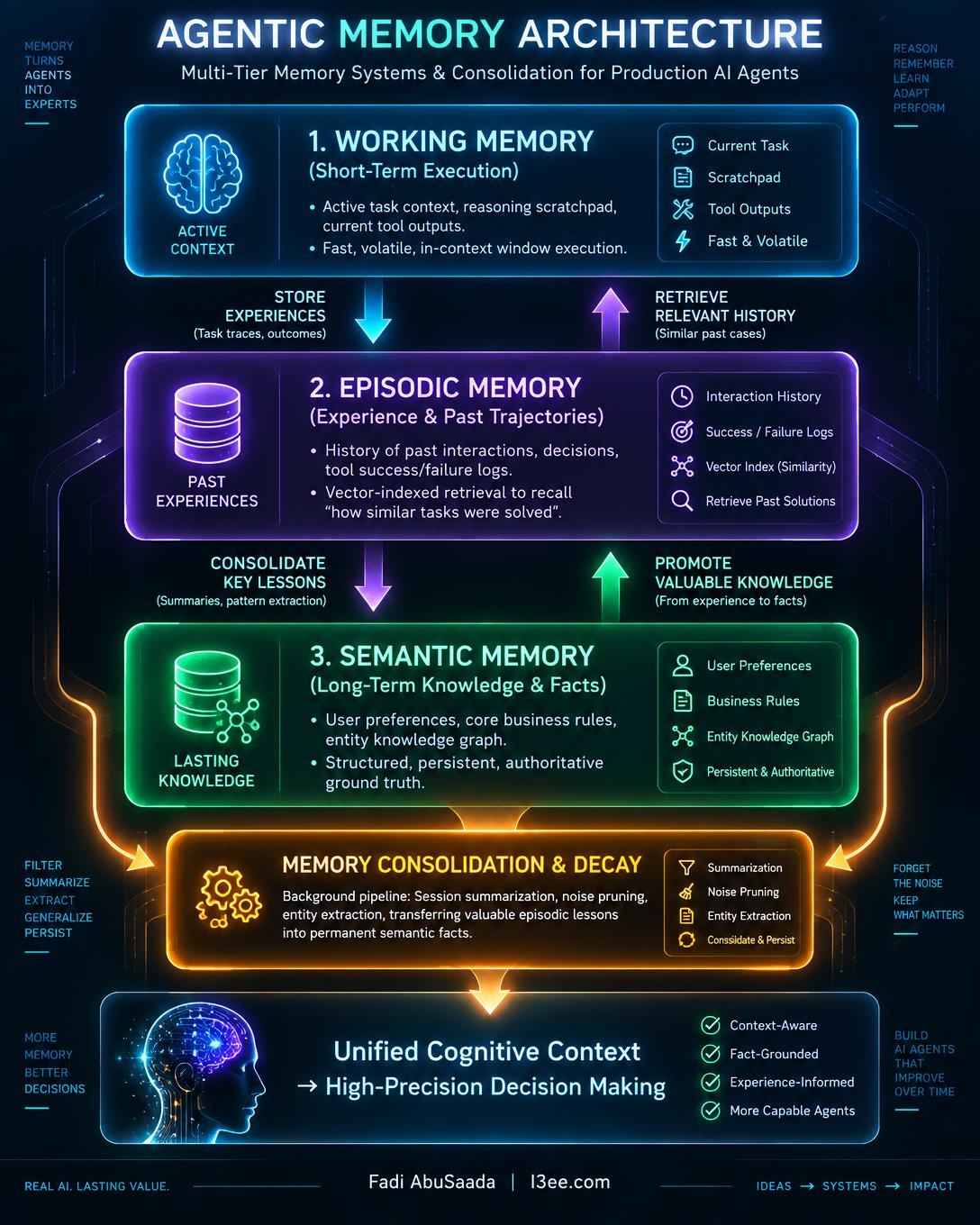
Every agent team eventually hits the wall: the conversation transcript outgrows the context window, the model starts forgetting instructions from thirty turns ago, and the reflex fix is to reach for a bigger window. Modern models now accept a million tokens or more — and the problem doesn't go away. Cost scales linearly with everything you keep in context, attention dilutes across the pile, and yesterday's decisions quietly rot into contradictions. This article maps what actually solves it: a multi-tier memory architecture with consolidation.
The core insight is that the context window is the agent's desk, not its filing cabinet. It holds what the agent is actively working on — nothing more. Everything crammed onto that desk is re-read and re-paid for on every single step, and the model has no built-in signal for what matters and what is stale noise. Memory is a separate subsystem with its own storage, retrieval, and lifecycle.
1. Why Context Window Expansion Is Not a Memory Solution
Even with windows large enough to hold an entire project's history, production agents degrade in predictable ways:
- →Context Drift — early decisions, constraints, and goals get contradicted by later turns; the model blends contradictory versions of "the truth" and its behavior becomes inconsistent
- →Lost in the middle — attention over long transcripts is uneven: models reliably recall the beginning and end of context and silently drop what sits in the middle
- →Cost per step scales with the transcript — every stored token is reprocessed on every model call, so a bloated window makes the agent slower and more expensive as it works
- →No persistence — when the session ends, everything evaporates; the agent starts every new conversation from zero, re-learning facts it already knew
- →No relevance signal — the window treats an API key, a user preference, and a failed tool call with identical weight; there is no mechanism to forget what stopped mattering
2. Working Memory: The Scratchpad
Working memory is the context window itself, used deliberately: the current task context, the reasoning scratchpad, and the most recent tool outputs. It is fast, volatile, and intentionally small.
- →Active task context — the current goal, the plan, and the immediate constraints the model must respect right now
- →Reasoning scratchpad — intermediate thoughts, decompositions, and self-corrections that only matter for the task in flight
- →Fresh tool outputs — the results of the last few actions; anything older either gets consumed into conclusions or archived to episodic memory
- →Fast and volatile — working memory is never persisted; it is rebuilt fresh each session and reset when the task completes
3. Episodic Memory: Experience and Past Trajectories
Episodic memory stores what the agent has lived through: past task trajectories, decisions taken, tool calls made, and whether each attempt succeeded or failed. Indexed with semantic embeddings, it lets the agent retrieve "how did I solve a similar problem before?" instead of improvising from scratch.
- →Interaction history — the record of past tasks, the user's requests, and how each was approached
- →Success and failure logs — which tools worked, which strategies dead-ended, and what the outcome of each attempt was
- →Vector-indexed retrieval — task traces embedded and searched by similarity, so a new task surfaces the most relevant past cases automatically
- →Experience-informed action — the agent retrieves past solutions before acting, skips approaches that already failed, and reuses what worked
4. Semantic Memory: Facts, Rules, and the Knowledge Graph
Semantic memory is the durable, authoritative layer: distilled facts, user preferences, core business rules, and structured entity knowledge. It is the ground truth the agent consults — persistent, curated, and deliberately separated from the noise of individual sessions.
- →User preferences — communication style, preferred tools, standing constraints; learned once, applied forever
- →Business rules — the fixed policies and domain truths that must never be inferred differently on different days
- →Entity knowledge graph — people, projects, systems, and their relationships stored as structured, queryable facts rather than prose
- →Persistent and authoritative — semantic memory changes deliberately (through consolidation), not incidentally (through conversation)
5. Memory Consolidation & Decay: The Background Pipeline
Memory that only grows becomes its own context-drift problem. Production systems run a background consolidation pipeline that continuously distills episodic history into semantic knowledge — and prunes what no longer earns its place.
- →Session summarization — raw transcripts are compressed into short summaries of what was attempted and what resulted
- →Promotion of repeated lessons — episodic outcomes that recur across sessions are upgraded into permanent semantic facts
- →Entity extraction — people, systems, and preferences mentioned in passing are resolved and written into the knowledge graph
- →Noise pruning and decay — stale, contradicted, or one-off details are demoted and forgotten, keeping retrieval precise and the agent focused
"The context window is what the agent is thinking about right now. Memory is everything it has learned well enough to never have to think about again."
The Architectural Takeaway
Working memory for the task in flight, episodic memory for experience, semantic memory for trusted knowledge, and a consolidation pipeline connecting them — that is the shape of an agent that stays coherent over months, not minutes. The payoff compounds: fewer repeated mistakes, decisions grounded in facts instead of re-derived guesses, lower token spend per step, and behavior that improves with every session instead of resetting to zero. The unified cognitive context this produces is what separates a demo from a production agent.