Beyond Vibe Checks: LLM Evals and Observability in Production
Why 'it feels right' isn't an engineering strategy — how automated evals, distributed tracing, and drift monitoring turn LLM systems from demos into reliable production software.
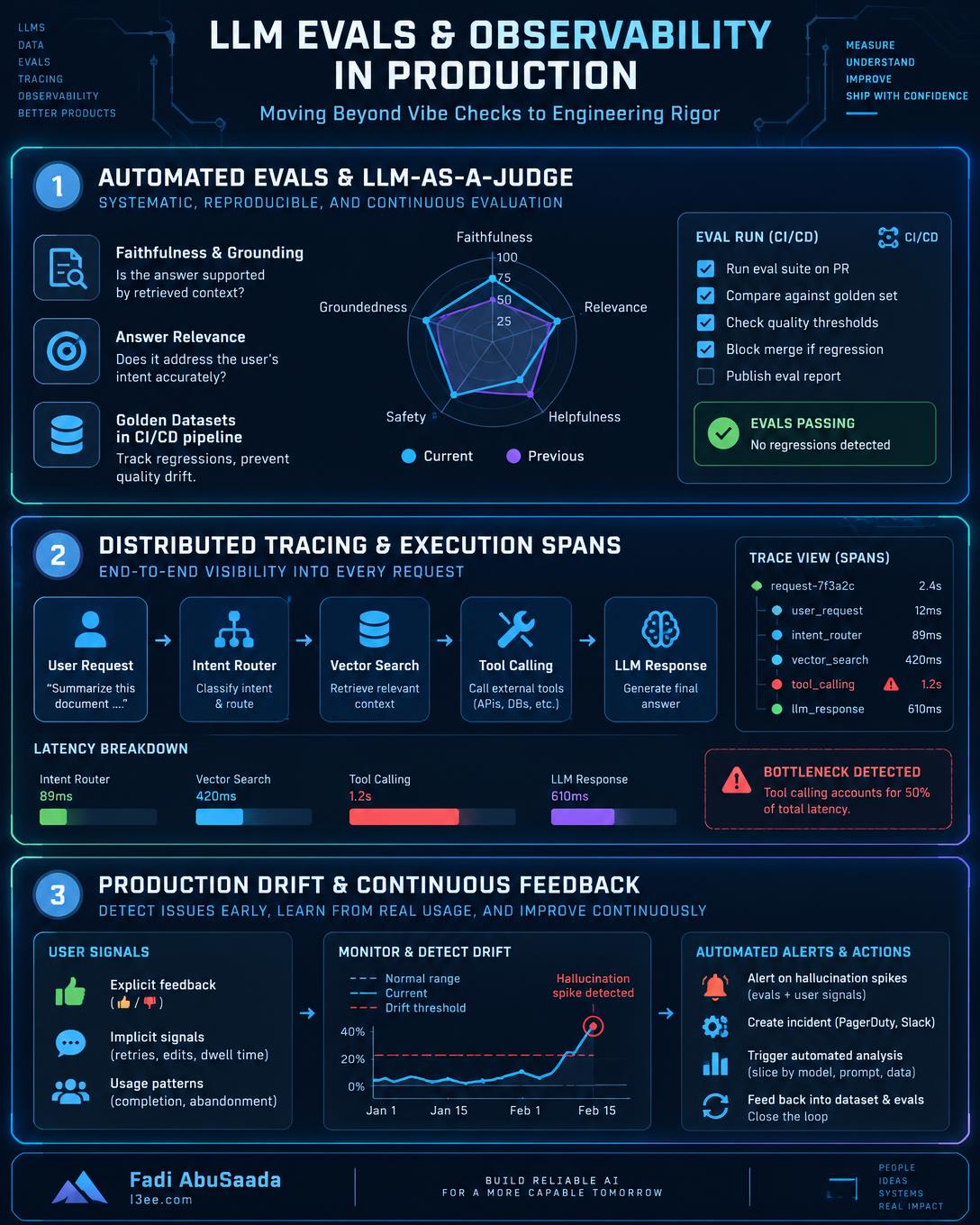
Traditional software testing is deterministic: same input, same output, pass or fail. You write a unit test, assert an exact value, and CI tells you in seconds whether the build is safe. LLMs break that contract. Ask the same question twice and you may get two different — both defensible — answers. There is no single "correct output" to assert against, and that's precisely why so many AI features ship on what engineers call vibe checks: a handful of manual prompts, a feeling that the answers look good, and a prayer that production traffic agrees.
Vibe checks don't scale, and worse, they don't survive change. A prompt tweak, a model version bump, or a new retrieval source can silently regress quality in ways no human eyeball will catch across thousands of daily requests. If you can't measure your LLM system, you're not maintaining it — you're hoping.
1. Automated Evals & LLM-as-a-Judge
The first step to rigor is making evaluation systematic, reproducible, and continuous. The core building block is a golden dataset: a curated set of representative inputs with known-good reference answers, covering the happy paths and the nasty edge cases. Against that dataset, you run automated evals on every meaningful change — ideally inside your CI/CD pipeline, exactly where unit tests already live.
- →Faithfulness & grounding — is the answer actually supported by the retrieved context, or is the model inventing plausible-sounding facts?
- →Answer relevance — does the response address what the user actually asked, or a nearby question it preferred to answer?
- →Regression tracking — compare each eval run against the previous one and block the merge when quality drops below threshold
The workhorse technique here is LLM-as-a-Judge: a strong model scores outputs against a rubric — faithfulness, relevance, helpfulness, safety. It's not perfect, but it's consistent, cheap, and it never gets tired on eval run number 400. Judges handle the fuzzy grading humans can't scale; the golden dataset handles the objectivity the judge can't provide. Together they turn "the bot feels smarter" into a score you can track on a chart.
2. Distributed Tracing & Execution Spans
Evals tell you the quality regressed. Tracing tells you where and why. A production AI request is not one model call — it's a pipeline: an intent router classifies the request, a vector search retrieves context, external tools are called, and only then does the LLM generate the final answer. If you log only inputs and outputs, you're debugging a black box.
Distributed tracing breaks each request into spans — user request, intent routing, vector search, tool calling, LLM response — each with its own duration and metadata. In one real trace I reviewed, the model call took 610ms, but a tool call inside the pipeline took 1.2 seconds. The bottleneck wasn't the LLM at all, and no amount of prompt optimization would have fixed it. Without spans, the team would have kept tuning prompts to solve a plumbing problem.
- →Trace the whole request lifecycle, not just the model call — routers, retrievers, tools, and post-processing each get a span
- →Record token counts, model version, and cost per span, not just latency
- →Alert on span-level anomalies: a vector search jump from 100ms to 2s is an infrastructure incident, not a 'quality issue'
3. Drift, Field Signals & Continuous Feedback
A system that passed evals at launch is not a system that passes evals today. Data drift and model drift are inevitable: your users start asking new question types, your knowledge base changes, and providers ship new model versions behind the same API. Quality decays quietly — until a customer notices before you do.
The defense is closing the loop between production signals and your eval pipeline. Collect explicit feedback (thumbs up/down), implicit signals (retries, message edits, abandonment), and usage patterns (completion rates, recurring topics). Monitor their aggregate distribution and alert when it drifts — a sudden spike in hallucination flags or retries is your early-warning system. Then feed those real failures back into the golden dataset and the eval suite, so every incident makes the next regression harder to ship.
"An LLM system without observability isn't a product — it's a demo with a payment plan."
The Practical Takeaway
You don't need a platform team to do this. Start with thirty golden examples, one judge-based eval run in CI, and basic tracing on your request pipeline. Measure, understand, improve, ship with confidence — that order isn't a slogan, it's the loop. The teams that win with AI aren't the ones with the best prompt; they're the ones who can prove, on every change, that quality moved in the right direction.